
What went wrong at Jaguar, and how other companies have succeeded by aligning their brand decision-making with their business strategy.
Last December, Jaguar announced the termination of its longtime Chief Creative Officer Gerry McGovern, as perhaps a final punctuation to its much-maligned EV “rebrand fail.”
To be sure, some of the more controversial creative decisions, such as abandoning the classic “leaper” logo and reorienting its identity around vivid colors, received the lion’s share of attention (and backlash) when the rebrand was unveiled.
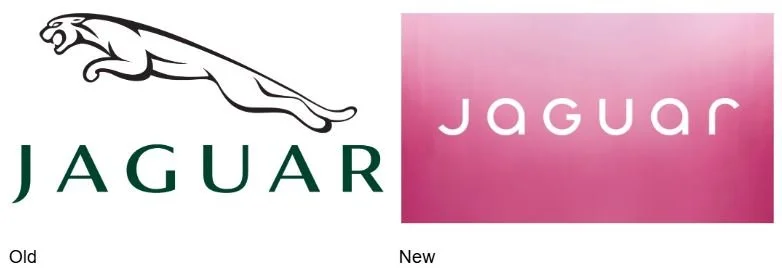
Source: The Branding Journal
But what caught my eye with the announcement of McGovern’s departure was how many people immediately took to social media to question why the blame should fall on the creative chief, and not higher up.
Here’s a quick sample of some of the harder-hitting commentary I saw.
“Jaguar’s rebrand was aimed at people who statistically cannot afford a new Jag.”
“Jaguar’s biggest mistake lies in its decision to go all-electric amidst a global decline in the electric luxury-class segment.”
“The rebrand destroyed more equity than it built.”
What this serves to illustrate is a greater underlying truth — one that we at CXO honor above all else:
How a brand shows up in the market is a creative decision. But how it is positioned is a business decision.
Another way of saying this is that when a company decides to invest its time and resources in a rebrand (which is a huge decision), it should be done to solve an existing business challenge — or capitalize on a clear business opportunity.
Apply this lens to any major rebrand in recent history, from Dunkin’ to Nokia to Cracker Barrel, and chances are those that succeeded in the long run were solving for a concrete strategic need, whereas those that faltered were using brand in an attempt to achieve something that was ultimately not a business imperative.
Leveraging brand positioning to solve a business challenge
The truth is that while visual rebrands tend to command the majority of public attention (whether they succeed or not), how a brand is positioned makes an equally sizable — if not greater — difference to an organization’s success. And if you start to look closer, you’ll see countless examples of companies who have excelled with brand positioning-led shifts where the biggest transformations showed up in how the company behaved, not how it looked.
With business outcomes as the driving force, it’s not surprising that many of these examples involve companies with a longstanding reputation who have sought to evolve their market perception without sacrificing precious brand equity.
Across almost half a century, IBM has transitioned from hardware manufacturing to enterprise consulting, with remarkably little change to its core brand identity. Similarly, American Express has shifted from a card-first orientation (“Don’t Leave Home Without It”) to a lifestyle-first orientation (“Don’t Live Life Without It”), again while largely retaining its classic visual brand attributes.
More recently, PwC is being lauded for just this kind of positioning-led approach following the launch of their revitalized brand, which is embodied by their new client-focused “So You Can” campaign. Rather than start with the cosmetic uplift, the PwC team began by identifying a research-driven insight about what their clients actually want (and get) from them — a strategic partner that enables their clients’ businesses to move forward. By extending its use to recruiting, PwC is demonstrating its new positioning offers a promise not only to clients, but also to its people.
To be clear, visual adjustments are an important component of a strategic repositioning. To support its evolution from EV car startup to sustainable energy and AI leader, Tesla tweaked its logo and dropped the “Motors” from its name. But as a result, we tend to think less about how the brand was re-imaged and more about how it was re-positioned.
Recently, we had the privilege of working with an iconic brand to support a bold business vision that included significant product portfolio consolidation and a refocusing of their target audience. But after developing a paradigm-shifting brand positioning, we agreed with our client’s decision not to make a significant visual change.
The reason was entirely business-driven. Instead of reaching for a new customer segment, the business strategy was to double-down on core strengths. So a major visual overhaul could have sent the wrong message to — and possibly alienated — the very customers the leadership team was betting the business on.
In the end, the business strategy wouldn’t have been significantly advanced with a reimagined visual identity. Our client revitalized their brand visuals to signal change, but it felt much more akin to a refresh than a full face-lift.
This took a lot of restraint and self-awareness on the part of leadership, but the proof of their good choices was demonstrated by an overwhelmingly positive market response. The fact that a positioning-led rebrand moved the needle so significantly for our client speaks to the strength in this approach.
Yes, rebranding is a powerful business lever. But as Jaguar knows all too well, if it isn’t being used to solve the right problem, it may do more harm than good.
Learn more about how brand can advance your business goals and support your strategic imperatives: Contact us at info@cxocommunication.com today.